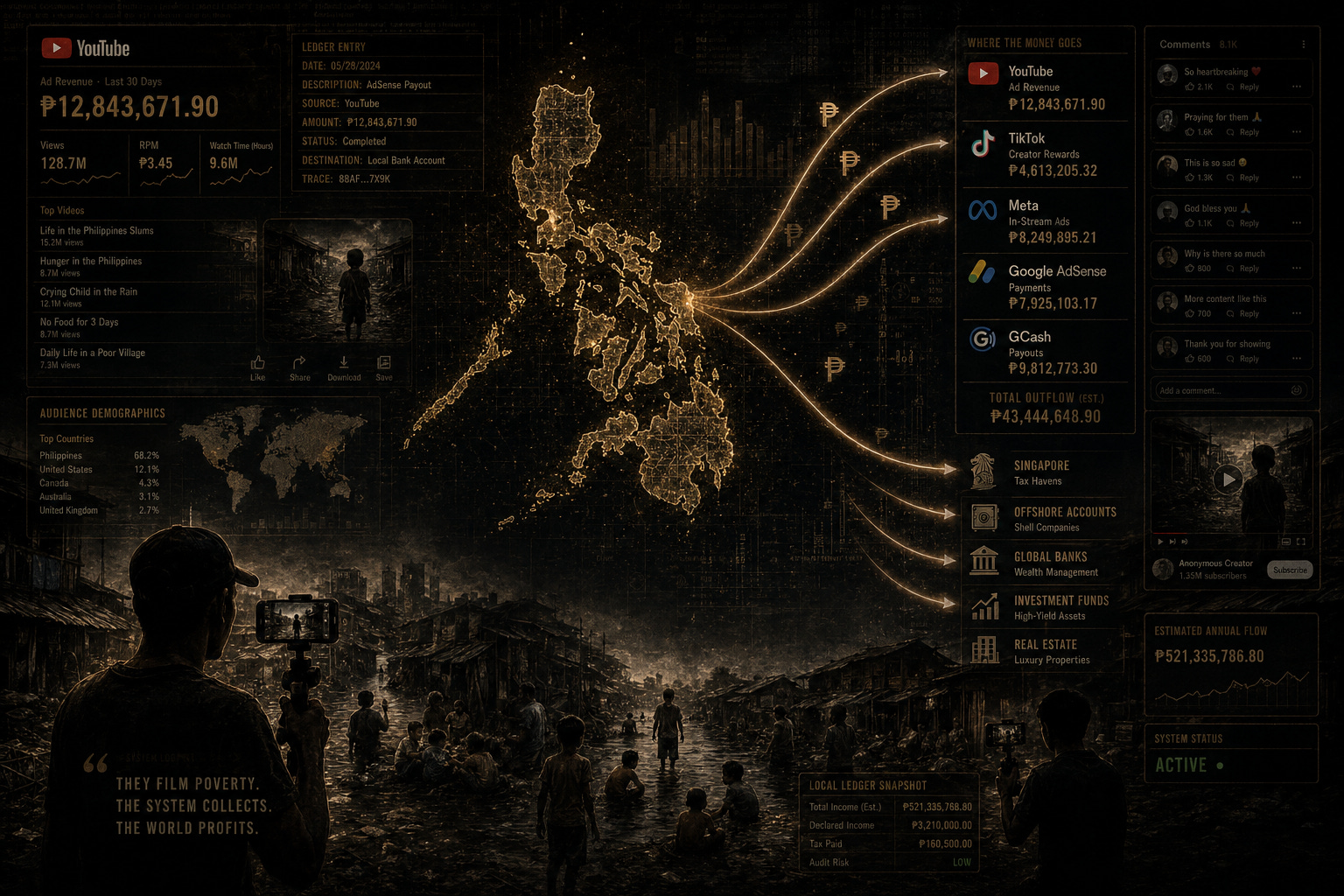
Seeds of Fire, Part III‑A: The Architecture of Extraction How the System Moves Money
How Philippine Poverty Becomes Image, Narrative, and Revenue While the Real Upside Flows Elsewhere
In the Philippines, money does not move in one direction. Wealth leaves through capital flight, platform fees, and investor exit, while poverty circulates back as content, spectacle, and justification. What looks like isolated exploitation is better understood as a system.
The Two Flows
Extraction here does not only happen in mines, contracts, or taxes. It also happens through cameras, platforms, and stories that convert inequality into value for somebody else.
In one channel of the system, Filipino wealth moves outward into global markets as investors seek shelter from local limits and currency devaluation. In another, poverty moves inward as image: filmed, framed, uploaded, and monetized through platforms whose incentives reward attention, emotional intensity, and repetition.
This is the architecture of extraction. It is not a single scam or one bad actor. It is a structure that turns vulnerability into circulation, circulation into revenue, and revenue into power.
Who Gets to Call It Exploitation?
Philippine media sits at the center of a class argument about who has the right to represent poverty and who benefits when they do.
“Poverty porn” is usually defined as the exploitation of stark images of extreme deprivation for sympathy, prestige, or fame. Defenders call it social realism that reflects conditions many audiences already know intimately.
That divide is not abstract. Research on Philippine media shows that lower‑income viewers often find emotional catharsis or even material aid in poverty programming, while wealthier audiences are more likely to read the same imagery as distasteful exploitation. The same shot of a flooded shanty or a crying child can function as testimony, commerce, and class signal all at once.
For an honest reader, this is the first principle: the debate is not simply whether poverty should be shown. The deeper question is who benefits from showing it, who controls the frame, and where the money goes after the audience clicks.
The ethical line is not about the subject matter. It is about the movement of value.
When Poverty Becomes a Visual Formula
Philippine independent cinema has repeatedly used poverty as a central subject or backdrop, not only as social context but as a narrative engine. In that framing, severe economic struggle becomes the motivation for characters’ decisions, including criminal acts, survival bargains, and moral collapse.
The aesthetic markers are specific:
Gritty handheld camerawork
Minimal lighting and visible grain
Unstable movement that feels like documentary
Production design saturated with waste, decay, and cramped space
These choices create a visceral sense of authenticity. They can also harden into a visual formula where “slum alley + shaking camera + crying child” becomes a kind of cinematic shorthand for national dysfunction.
Academic work on Philippine cinema notes that in 2009, over a quarter of the population lived below the poverty line, making poverty a statistically common backdrop for storytelling. Filmmakers often defend their use of impoverished settings by claiming they are simply showing the reality many Filipinos already navigate. In Brillante Mendoza’s 2009 film Kinatay, for example, severe economic struggle is written as the primary motivation for the characters’ involvement in criminal activity.
To convey these harsh realities, directors rely on specific visual strategies: gritty, handheld camerawork with minimal lighting and stabilizers, intentionally revealing a low‑budget nature that invites the audience into a visceral experience of impoverished communities. Production design heavily features waste—whether human, biological, or industrial. In some films, waste has evolved from simple set decoration into a kind of recurring symbol: proof that the setting is authentically “poor enough” to be believable.
At the same time, defenders of this cinema argue that such work forms a post‑colonial aesthetic by centering the authentic struggles of the Filipino masses and challenging the dominance of Western visual norms. That defense matters and cannot be dismissed.
But it does not cancel the economic question. Even if a work is aesthetically serious, politically conscious, or anti‑colonial in intention, the question remains:
Who converts this suffering into durable value?
Is it the community on screen? The director? The festival circuit? The platform?
💡 Why This Investigation Needs You
This story took 18 hours of research, eight sources, NotebookLM synthesis, and cross‑referencing capital‑flight data with poverty‑content monetization patterns. The first half is free because I believe transparency should be accessible.
But investigative journalism at this depth costs time, tools, and focus. If this work matters to you—if you want to read how the platforms enable extraction, where the money really goes, and who profits from the loop—consider becoming a paid subscriber.
What you get for $5/month
Full access to all Seeds of Fire investigative parts
The PovertyPimps Database (name tracking, revenue estimates, platform connections)
Exclusive research breakdowns and Substack Notes on new findings
Direct input: vote on which investigative threads I pursue next
Can’t afford it? Share this piece. Every forward, restack, and tag helps this reach the people who need to see it.