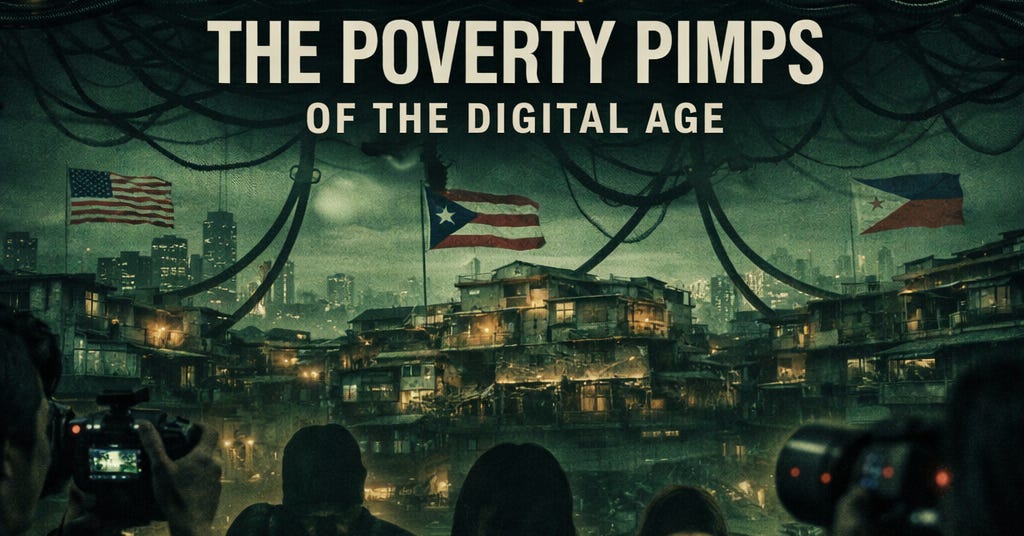
Seeds of Fire — Philippines: A Former Poverty Pimp Investigates the Poverty Porn Machine (Coming Soon)
An investigation by a former poverty pimp who helped build this machine and is now pulling receipts on how it really works.
SEEDS OF FIRE: POVERTY PORN AND THE NEW AGE POVERTY PIMPS (PHILIPPINES EDITION)
Most people think “poverty porn” is just an ugly phrase.
In the Philippines, it’s an industry: a content pipeline, a fundraising machine, and a cultural flashpoint where faith, charity, and platform economics collide.
This isn’t a thinkpiece. It’s the opening salvo of an extensive investigation into how, exactly, other people’s hunger, disability, and grief get turned into views, donations, and reputations in the digital age.
What I mean by “poverty porn”
When I say poverty porn, I’m talking about a commercial and reputational strategy:
Take staged or selectively framed deprivation — especially children, elders, disabled people, and other vulnerable communities.
Package their suffering into emotionally engineered content.
Convert that content into attention (views, shares), money (ads, “fan funding,” donations), and moral capital (“good Samaritan” branding).
It’s not just about taste or tone. It’s a dignity and power problem:
Who controls the narrative.
Who benefits financially.
What is asked of the poor to make the story legible and viral.
What safeguards (if any) exist for consent and long‑term welfare.
This series, Seeds of Fire — The New Age Poverty Pimps: Philippines Edition, is about following that chain from thumbnail to bank account.
Three markets of poverty porn in the Philippines
In the Philippines, the phenomenon shows up in at least three overlapping “markets.”
1. The charity‑vlogging creator economy
First is a high‑volume creator economy built around “charity vlogging” and “social experiment” formats, where creators film help as entertainment.
Patterns you’ll recognize:
Channels that turn recipients into recurring characters and serial arcs.
Emotionally optimized editing, cliffhangers, and “before/after” reveals to sustain watch time and donations.
“Rescue” thumbnails designed to make you feel like you’re doing a good deed just by clicking.
The country’s exceptionally high YouTube usage creates fertile demand for this emotional, episodic content. The algorithm rewards whatever keeps people watching; these channels have learned exactly which stories of suffering perform.
2. Broadcast, documentary, and tabloid ecosystems
Second is professional TV, film, and tabloid‑style digital media that have long leaned on poverty‑focused narratives — exposés, human‑interest segments, and disaster coverage.
For years, Philippine film and TV criticism has wrestled with the question:
When does “realism” cross the line into exploitation?
You see this tension in independent cinema controversies and in satire like Ang Babae sa Septic Tank, which mocks the award‑chasing “poverty film” formula even as it still relies on poverty as its central set‑piece.
3. Institutional fundraising and brand philanthropy
Third is institutional fundraising and brand philanthropy: NGOs, church networks, and corporate foundations that depend on poverty imagery to mobilize donors.
Compared to vloggers, these organizations usually have better transparency tooling:
Annual reports
Audited financial statements
Program disclosures and impact blurbs
But they’re not immune to the same pressures. Donor acquisition incentives pull storytelling toward:
pity and simplification
“deserving poor” archetypes
stories that make the giver feel heroic and central
The line between honest depiction and poverty porn is thin — and the poorer you are, the more likely someone else is drawing it for you.
When “help content” meets regulation
Regulatory pressure in the Philippines is starting to catch up, both on methods and operations.
On the methods side:
Data and privacy authorities have issued guidance that explicitly covers vloggers using body‑worn cameras and similar devices.
Requirements include privacy notices, lawful basis for filming, and special safeguards for vulnerable data subjects.
On the operations side:
Regulators have intervened when “help content” morphs into operating unlicensed welfare facilities or running public solicitations without permits.
One high‑profile example involves the vlogger known as BenchTV, whose activities prompted closure/suspension orders around a “care” setup that blurred the line between content house and welfare facility.
The message is simple: you can’t hide a social service operation behind a YouTube channel forever. But enforcement is patchy, and the platforms themselves are built to reward anyone who can keep the audience crying and clicking.
The money problem: opacity by design
On funding, the central investigative problem is opacity.
Revenue often blends:
in‑stream ads and programmatic placements
“fan funding” (Super Chats, memberships, channel donations)
off‑platform contributions via GCash, PayPal, bank transfers, and private group drives
YouTube publishes general revenue‑share rules — for example, the baseline 55% of net ad revenue to creators for watch‑page ads, and 70% of net revenue for some fan‑funding features. But it offers almost no public visibility into whether a specific channel is actually monetized, or how much it earns.
Third‑party sites (Social Blade, vidIQ, etc.) throw out earnings estimates. Those are model‑based ranges, not audited statements. They’re useful as triangulation signals, not as proof you can print.
Meanwhile:
Scam and fake‑aid content circulates across the Philippine information environment, including AI‑generated “aid” clips fronting for phishing and fraud.
“Dark money” in the strict sense — covert political or criminal financing — doesn’t show up in open dashboards. Proving it would require forensic work: business registrations, donor tracing, bank records, subpoenas.
In this series, I’ll treat dark‑money questions as hypotheses, not conclusions, unless there is documentary evidence strong enough to name.
The Catholic context: help, spectacle, and the soul
You can’t talk about poverty and charity in the Philippines without talking about the Church.
“Poverty porn” collides head‑on with:
a deep Catholic tradition of almsgiving and institutional charity
parish‑run relief drives, Lenten programs, and national campaigns coordinated by church bodies
the instinctive belief that helping the poor is a non‑negotiable part of Christian life
The critique is not that help is bad.
It’s that help performed for applause risks instrumentalizing the poor — turning them into props for someone else’s public virtue and reward.
This sits squarely in line with Pope Francis’s repeated warnings against performative charity and his insistence on a dignity‑first encounter with the poor: seeing them as subjects with agency, not as raw material for your testimony or your channel.
In other words: the theological fight over “poverty porn” is a fight over who gets to be fully human on camera.
How this investigation will work
This report — and the wider Seeds of Fire series — maps poverty porn as a business and production phenomenon across creator platforms, mainstream media, and institutional fundraising.
Sources and methods
I’m drawing on:
channel analytics dashboards (subscriber counts, upload patterns, content themes)
platform policy documents and monetization rules
Philippine regulatory advisories, orders, and press coverage
NGO and foundation donation portals, campaign pages, and reports
Filipino‑language commentary, watchdog posts, and academic / critical writing
Who gets named — and why
Selection logic for naming specific producers:
They publish recurring poverty‑centered charity/help content, slum‑tour content, or poverty‑framed “social experiments”; and/or
They are repeatedly discussed in Filipino discourse as examples of poverty porn; and
They leave enough public metadata (videos, descriptions, appeals, organizational traces) to cite responsibly.
This will not be exhaustive. Treat it as a starting roster for a long‑form investigative series, not as a definitive blacklist.
Key limitations
I want the boundaries clear from the start:
Open web access to individual YouTube video descriptions can be throttled. That means funding links (GCash, PayPal, bank details) can’t always be scraped or mapped at scale. Most funding‑path analysis will be structural (how creators monetize) plus case‑based (where regulators or news documents specific schemes).
Third‑party earnings estimates are not books. They’re hints, not evidence. Wherever possible, I’ll present them as ranges and pair them with other documentation.
Where the trail goes cold at the edge of subpoenas or private banking data, I’ll say so. I’d rather name the gap than fill it with speculation.
Why this matters — and who it’s for
This series is for people who are tired of being told that the only options are:
do nothing, or
accept exploitation because “at least someone is helping”
If Seeds of Fire — The New Age Poverty Pimps: Philippines Edition does its job, then:
creators and institutions who think “no one will ever connect these dots” will have to think twice
community organizers will have receipts, not just uneasy feelings about a channel that doesn’t quite add up
families living in front of these cameras will have language and documentation to push back against being used as content
This is long‑form, document‑heavy work. It will take time, records, and more than one monthly check.
How to follow — and how to help
You’re reading a coming‑soon version of an investigation that will roll out in multiple parts.
To make sure you see it:
Stay subscribed to this publication.
If you can, support the work so I can keep paying for hosting, tools, and records.
I’m a disabled U.S. veteran on Social Security, running this project out of what’s left of one check at a time. No sponsors. No party machine. No brand pipeline to “monetize my story.” Just court records, audits, screenshots — and people who are done watching their pain turned into somebody else’s growth hack.
Seeds of Fire — The New Age Poverty Pimps: Philippines Edition is in production.
The thumbnails are already out there. Now it’s time to see the ledger behind them.
Support this investigation
*Seeds of Fire — The New Age Poverty Pimps: Philippines Edition* is months of document work, not a weekend thread. If you want this kind of investigation to exist outside newsrooms and PR, here’s how you can keep it going:
- **GoFundMe (one‑time boost):**
https://www.gofundme.com/u/vault-archivist
- **Ko‑fi (small, flexible support):**
https://ko-fi.com/thevaultinvestigates
- **PayPal (direct):**
https://www.paypal.com/ncp/payment/JH4X7243NJMRE
Your support covers records, tools, hosting, and backups — not yachts or junkets. If you can’t give, sharing the work with someone who can is just as critical.