Seeds of Fire — Special Report: The New Age Poverty Pimps: Philippines Edition
Part I: Smile for the Camera — How Philippine Poverty Became Content
March 12, 2026
In collaboration with Anonymous Media Group Anonymous - Anonymous Official and The Dirty Dozen Dispatch, we continue our Seeds of Fire series with a special report on how faith, platform economics, and the business of charity turned Filipino poverty into one of YouTube’s most profitable content genres.
Dear friends,
Fifty-nine million, six hundred thousand Filipinos are on YouTube.
That is not a statistic.
That is an audience.
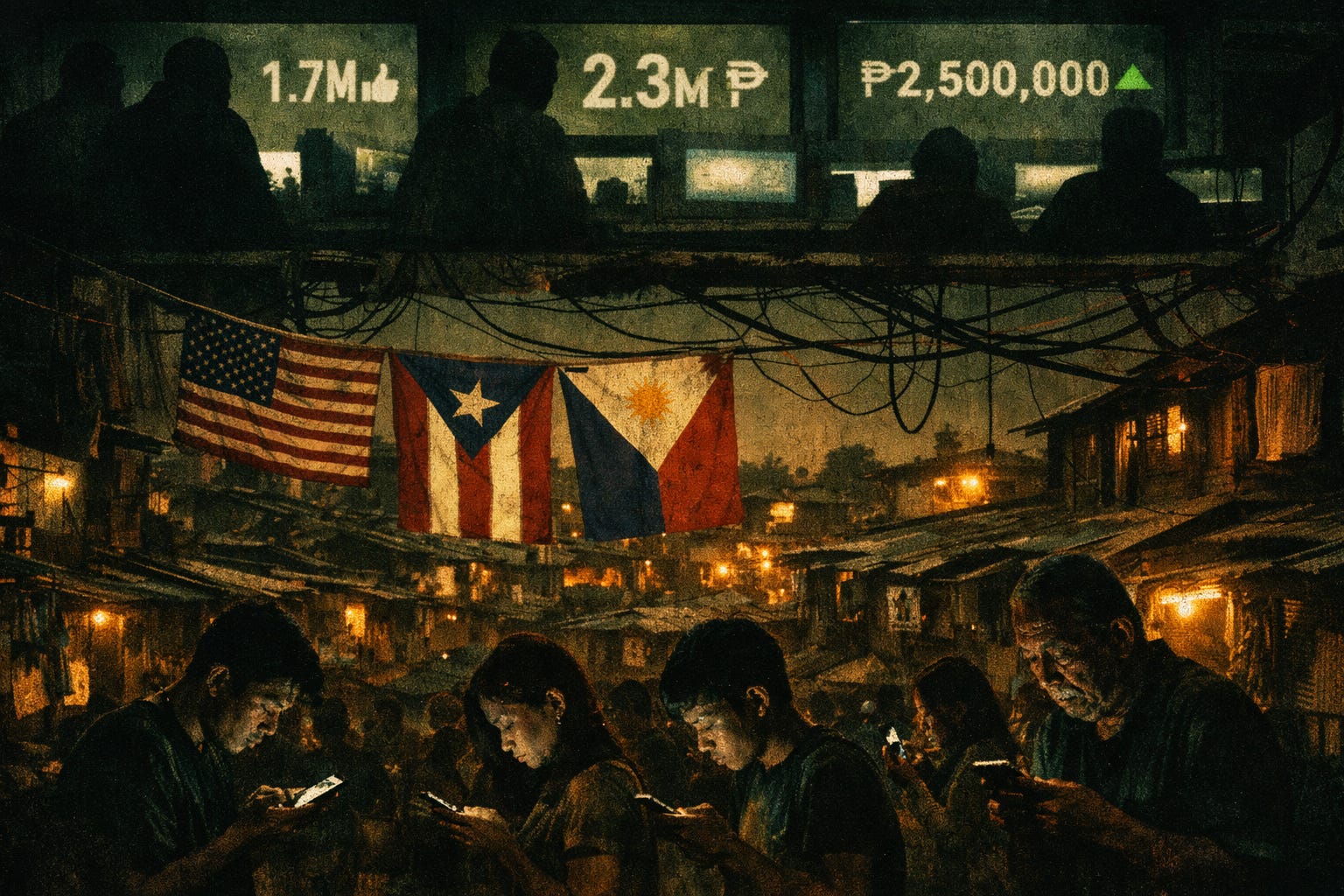
And someone — several someones, with channels, cameras, and monetization enabled — built a business around showing those 59.6 million people the poorest corners of their own country.
Optimized for tears.
Edited for watch time.
Monetized by the click.
They call it tulong.
We call it a business model.
This is Part I of Seeds of Fire: Special Report — The New Age Poverty Pimps, Philippines Edition.
Before we name names — and we will name names — we need to understand the machine.
How it was built. How it earns. Why it works. And why 59.6 million viewers keep watching.
Because this machine does not run on bad intentions. It runs on something far harder to fight: emotional logic that feels exactly like generosity
WHAT WE MEAN WHEN WE SAY “POVERTY PORN”
Let us be precise.
“Poverty porn” is not a vibe complaint. It is not about aesthetics or sensitivity. It is a commercial and reputational strategy with a specific, documented structure:
Step 1. Take staged or selectively framed deprivation — especially children, elderly people, disabled persons, and other vulnerable communities.
Step 2. Package their suffering into emotionally engineered content: crying close-ups, before-and-after reveals, cliffhanger “will they make it?” arcs.
Step 3. Convert that content into three currencies:
— Attention: views, shares, algorithm rewards
— Money: ad revenue, fan funding, off-platform donations
— Moral capital: “good Samaritan” branding, the halo of being seen to help
The product is the image of suffering.
The customer is the viewer.
The profit goes to the producer.
The subject — the person being filmed — gets whatever the camera decides to leave them with.
This is a dignity and power problem before it is anything else.
Who controls the narrative? Who benefits financially? What is asked of the poor to make the story legible, shareable, and viral? What consent exists — and who enforces it?
These are the questions this series will answer.
THREE MARKETS — ONE PRODUCT
The poverty content economy in the Philippines runs through three overlapping markets. They use the same raw material. They serve different audiences. They face very different levels of accountability.
MARKET ONE: THE CREATOR ECONOMY
This is the fastest-growing and least-regulated sector.
High-volume YouTube channels and Facebook pages built entirely around “charity vlogging” — filming help as entertainment.
The format is almost algorithmically standardized:
Recipients become recurring characters. The same homeless man. The same sick grandmother. The same hungry children — week after week, each episode a new crisis, a new reveal.
Editing is emotionally engineered. Slow-motion tears. Swelling music. The “before” shot dirty and desperate. The “after” shot clean and grateful.
Thumbnails are designed to perform one function: make you feel like clicking is a moral act.
The Philippines is the perfect market for this content. YouTube’s ad-reachable audience in the country: 59.6 million users as of late 2025. The Philippines ranks among the top YouTube-engaged nations globally.
That is the stage. These channels know how to fill it.
MARKET TWO: BROADCAST AND DOCUMENTARY
Before YouTube, there was television.
Philippine broadcast journalism has a long history of poverty-centered documentary and human-interest content — and a long, serious internal debate about where “realism” ends and exploitation begins.
GMA’s i-Witness documented pagpag — the practice of salvaging discarded food from dumpsites — and urban poor survival strategies before most creators had a smartphone.
The tension was real then. It remains real now.
The 2011 film Ang Babae sa Septic Tank satirized the award-chasing “poverty film” formula — an indie director who uses extreme poverty as a set-piece to win festivals — even as the film itself could not entirely escape the same critique.
GMA journalist Kara David put it plainly: “Uplift the poor, uplift their dignity — not just stories that generate pity.”
That standard exists. It is not always applied.
MARKET THREE: INSTITUTIONAL FUNDRAISING
The third market is the oldest.
NGOs, Catholic church networks, and corporate foundations have used poverty imagery to mobilize donors for decades — long before YouTube existed.
They typically operate with more disclosure: annual reports, audited statements, program summaries. They are registered. They file with regulators.
But “more accountable” is not “immune.”
Donor acquisition pressure pulls institutional storytelling in the same direction as creator content: pity over dignity, “deserving poor” archetypes, stories where the giver is the hero.
The difference between an NGO campaign and a charity vlog is often not the content. It is the spreadsheet behind it.
THE NUMBERS THAT MATTER
Let us talk about scale.
59.6 million — YouTube’s ad-reachable audience in the Philippines (DataReportal, late 2025).
1.37 billion — Total views for one major charity vlog channel as of this investigation. Channel created: December 2019. That is five years to build a billion-view poverty content machine.
3.64 million — That same channel’s subscriber count. Built on a “kalingap” (caring) brand identity. Family serial format. Recurring characters. Emotionally optimized episode structure.
4.09 million — Subscribers on a second major charity vlogging channel, created August 2016. Total views: approximately 896 million.
20.2 million — Subscribers on a celebrity “social experiment” help channel. Total views: 1.89 billion and rising. This channel has faced documented poverty porn accusations in Philippine mainstream media.
These are not small operations. These are media companies built on the infrastructure of Filipino poverty.
HOW THE MONEY FLOWS — THE PLATFORM LAYER
YouTube does not hide how it shares revenue. It just makes the numbers hard to track at the channel level.
Here is what YouTube publicly discloses:
55% of net ad revenue from watch-page ads goes to the creator. 45% goes to YouTube.
70% of net revenue from fan-funding features — Super Chat, channel memberships, Super Thanks — goes to the creator. 30% goes to YouTube.
This creates a double incentive for poverty content.
Ads pay for scale. Every view on a 1.37-billion-view channel generates ad revenue at the 55/45 split.
Fan funding pays for emotional intensity. Live streams where audiences donate in real time to “help” a subject on camera generate revenue at the 70/30 split. The more desperately the subject suffers on camera, the more the audience feels the need to donate in the moment.
YouTube is not a passive platform here. YouTube earns 30 to 45 percent of every dollar generated by this content.
In 2024, YouTube quietly removed the public flag that previously indicated whether a channel was in the YouTube Partner Program — making it harder for watchdogs to determine which channels are monetized.
The platform made itself less transparent at the same moment the genre was at its peak.
That is not an accident. That is design.
WHERE THE MONEY GOES AFTER THE PLATFORM
Beyond YouTube, the funding flows are deliberately diffuse.
Philippine charity vloggers commonly collect donations through GCash, Maya, bank transfers, PayPal, YouTube Super Chat, and GoFundMe.
The critical governance point: in the Philippines, public solicitation is regulated.
The DSWD requires anyone conducting public solicitation for charitable or welfare purposes to obtain a public solicitation permit. The permit process requires disclosure of leadership, a stated program plan, and compliance with the 70/30 rule — meaning at least 70% of funds raised must go to programs.
Most charity vloggers do not have this permit.
You can post a GCash number in a YouTube video description, collect millions in donations, and face no automatic disclosure requirement.
That is the architecture of opacity.
THE BENCHTV CASE: WHEN CONTENT BECOMES A FACILITY
The vlogger known as BenchTV — approximately 512,000 subscribers, approximately 58.6 million total views — built a following around “rescue” content: filming homeless individuals, narrating their stories, documenting their “transformation.”
At some point, the filming became something else. The creator began housing the people being filmed.
DSWD inspectors found an unlicensed care facility in operation, minors present on the premises, and no proper licensing or registration.
The facility was shut down.
BenchTV is not a unique case. BenchTV is a visible case.
The question this case raises is not about BenchTV. The question is: how many channels are running the same operation without DSWD ever showing up?
THE BACKLASH PATTERN: WHY THE MACHINE SURVIVES CRITICISM
The charity vlogging machine has faced criticism. It has survived every wave of it.
The reason is a split audience phenomenon best illustrated by the Ivana Alawi controversy.
When documented poverty porn accusations emerged in mainstream Philippine media, two audiences responded:
Side A: “At least someone helped.” Emotional satisfaction. Gratitude for visibility.
Side B: “Why did it have to be filmed?” Dignity concern. Questions about consent and financial accountability.
Both audiences are real. Both responses are genuine.
The machine survives because it satisfies both simultaneously.
You feel good about watching because someone got helped. You don’t ask where the rest of the money went.
The architecture of the genre is designed to make the first feeling available immediately and the second question feel like ingratitude.
WHAT IS COMING IN PARTS II THROUGH VI
Part II — The Roster: Names, channels, subscriber counts, estimated earnings, the full BenchTV timeline.
Part III — Follow the Peso: The full money trail. YouTube’s revenue architecture. GCash donation rails. DSWD permit compliance.
Part IV — The Catholic Machine: How the Church built the infrastructure of charitable giving in the Philippines — and how the charity vlogging industry borrowed the language without the theology.
Part V — The Regulators: What the NPC, DSWD, and Philippine child protection law actually say — and the gap between the rule on paper and enforcement in practice.
Part VI — The Reckoning: Community voices. TruthDrop submissions. What accountability looks like when it actually arrives.
WHAT WE NEED FROM YOU
This investigation runs on documents, not assumptions.
If you are a social worker, DSWD employee, community organizer, or someone who has been filmed without meaningful consent — we want to hear from you.
Your identity is never stored. Your IP is never logged. Every submission is encrypted.
Submit anonymously: https://truthdrop-5buxndbh.manus.space/tips
Researchers and journalists — apply for archive access: https://vet.thevault.watch/
THE LINE THIS SERIES IS DRAWING
We are not saying help is wrong.
We are not saying visibility is exploitation.
We are not saying every charity vlogger is a criminal.
We are saying:
When the camera is also the revenue source, the suffering on screen is also a product.
When donations flow through unregistered channels into unaudited accounts, “charity” is a hypothesis, not a fact.
When a channel earns 1.37 billion views on poverty content and publishes no audited accounts, that is not transparency. That is opacity with a thumbnail.
The poor in this story did not choose to be content. Someone else made that choice. And someone else collected the money.
We are following the money.
We are building the timeline.
We are keeping the receipts.
The thumbnails are already out there.
Now it’s time to see the ledger behind them.
SUPPORT THIS WORK
This investigation is part of Seeds of Fire — a long-form, document-heavy series by The Vault Investigates. Independent. Veteran-run. No institutional funding.
I am a disabled U.S. veteran on a fixed VA disability and Social Security income. No sponsors. No brand pipeline. No party machine. Just court records, audits, screenshots — and people who are done watching their pain turned into somebody else’s growth hack.
If this work matters to you:
Ko-fi — Give $5, $10, $15 or whatever you can:👇
PayPal — One-time annual support ($60):👇
GoFundMe — One-time boost, any amount:
Have documents or tips from the Philippines?
Submit anonymously:
Researchers and journalists — apply for archive access:
The Vault Investigates is an independent archive documenting the business of poverty. We follow the money. We take no political stance. We stay in our lane.
@thevaultarchivist on X · Facebook · Instagram


