

A Proposed Grades 11–12 educational program from The Vault Investigates focused on source verification, public-source research, digital journalism, privacy, and responsible evidence-based communication. Every student with a smartphone now carries something earlier generations could only imagine: a publishing platform.
A photograph can reach thousands of people within minutes. A rumor can cross a school before the first class ends. A misleading video can look credible because it has captions, music, confident narration, and thousands of views.
The problem is no longer simply access to information.
The problem is knowing what deserves to be believed.
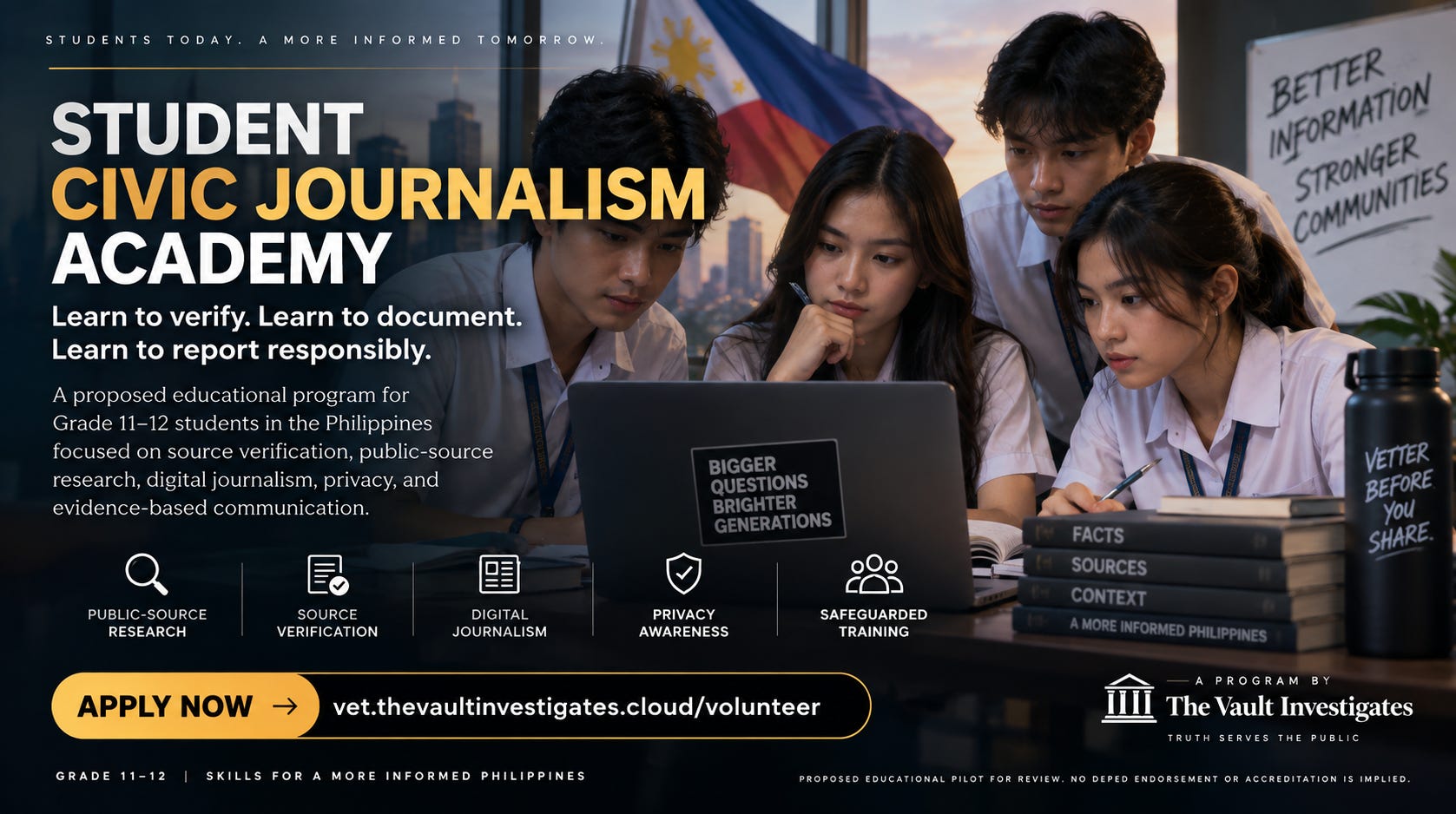
That is the challenge behind the Student Civic Journalism Academy, a proposed educational program from The Vault Investigates for students in Grades 11 and 12.
Its central lesson is simple:
Verify before you share. Document before you claim. Report responsibly.
Students Are Growing Up Inside an Information Battlefield
Young people do not experience the internet as something separate from daily life.
News, entertainment, schoolwork, politics, advertising, advocacy, rumors, livestreams, AI-generated material, edited videos, and personal opinions can all appear in the same feed.
And increasingly, they look alike.
A professional-looking post is not necessarily accurate.
A viral video is not necessarily evidence.
A screenshot is not automatically authentic.
A person speaking confidently into a camera is not automatically an expert.
A claim repeated thousands of times does not become true simply because an algorithm keeps serving it to people.
The ability to navigate this environment is becoming a basic civic skill.
Students need more than warnings about misinformation.
They need practical experience answering questions such as:
Who published this?
What is the original source?
Can the claim be independently verified?
Is the evidence current?
Has information been removed from its original context?
What information should not be collected or published?
When do we need to say, “We do not know yet”?
Those are journalism questions.
They are also research questions, digital citizenship questions, and civic responsibility questions.
What Is the Student Civic Journalism Academy?
The Student Civic Journalism Academy is designed as a structured, supervised learning environment for senior high school students.
It is not a pathway into unrestricted investigations.
It is not a hacking program.
It is not a surveillance operation.
And students are not given unrestricted access to private records, sensitive databases, whistleblower identities, or internal administrative systems.
Instead, students learn how responsible research works using bounded educational assignments, public information, defined roles, safeguarding rules, and human review.
The proposed program concentrates on five areas:
Public-source research
Students learn how to locate and evaluate information that is legitimately available to the public.
That includes identifying original sources, distinguishing primary from secondary reporting, comparing claims across credible sources, and recording where information came from.
Source verification
Students learn that finding information is only the beginning.
They must ask whether it can be verified.
Dates matter.
Original documents matter.
Context matters.
Corroboration matters.
And sometimes the correct conclusion is that available evidence is insufficient.
Digital journalism
Students learn the fundamentals of communicating verified information clearly and fairly.
That means separating fact from opinion, avoiding sensationalism, respecting context, identifying uncertainty, and understanding that publication creates responsibility.
Privacy and consent
Good research is not simply about discovering what can be found.
It is also about understanding what should be collected, retained, shared, or published.
Students are taught to consider privacy, dignity, consent, and potential harm before treating information as content.
Evidence-based thinking
Perhaps the most important lesson is learning to distinguish a claim from evidence supporting a claim.
That habit extends far beyond journalism.
It applies to academic research, civic participation, social media, employment, and everyday decision-making.
Three Student Learning Pathways
The proposed Academy currently includes three bounded training pathways.
Junior Public-Source Research Trainee
Students learn the fundamentals of locating public information, documenting sources, comparing records, and maintaining a basic research trail.
The emphasis is not on finding secrets.
It is on learning how to work carefully with information that is already legitimately available.
Data Verification Trainee
This pathway focuses more deeply on confirming whether information is accurate, current, attributable, and supported.
Students practice comparing records, identifying inconsistencies, checking source quality, and documenting verification decisions.
Digital Journalism Apprentice
Students learn how verified research becomes responsible public communication.
That includes headlines, sourcing, context, fairness, corrections, evidence presentation, privacy considerations, and the difference between reporting and speculation.
Human Review Is a Feature, Not a Limitation
One of the most important principles of the program is that students should not be expected to make high-risk decisions on their own.
Training activities are supervised.
Work is reviewed.
Progression is structured.
Completion is documented.
The goal is education, not production pressure.
A student should be able to make a mistake inside a controlled training environment and learn why it was a mistake.
That is what education is supposed to provide.
Human review also teaches something increasingly important in an AI-driven information environment:
Automation can assist judgment. It should not replace accountability.
What Students Will Not Be Asked to Do
Responsible education requires boundaries.
Participants should not be asked to:
investigate private individuals using restricted or deceptive methods;
access private databases or confidential records;
identify confidential sources;
engage in covert surveillance;
make automated adverse decisions about people;
publish allegations without review;
gather unnecessary personal information;
circumvent website security or access controls;
act as unsupervised investigators.
The Academy is built around a very different idea:
Teach the method without exposing students to unnecessary risk.
Why This Matters Beyond Journalism
Not every student who participates will become a journalist.
That is not the point.
A future engineer should know how to evaluate evidence.
A future teacher should know how to distinguish reliable information from unsupported claims.
A future entrepreneur should know how to verify sources.
A future public servant should understand documentation and accountability.
A future voter should know the difference between persuasion and evidence.
And every young person navigating social media should understand that sharing information is itself an action with consequences.
These are transferable skills.
They belong in the modern civic toolbox.
From Passive Consumers to Responsible Researchers
Too much digital-literacy education tells students what not to do.
Do not believe everything online.
Do not click suspicious links.
Do not share misinformation.
Those warnings are necessary, but they are incomplete.
The Student Civic Journalism Academy takes the next step.
Instead of only telling students to be careful, it teaches them how to investigate a claim responsibly.
Instead of simply saying “check your sources,” students learn what source verification actually looks like.
Instead of warning them about misinformation after it appears, students learn the habits that make misinformation easier to recognize.
The shift is important.
Students move from passive consumers of information toward responsible participants in the information ecosystem.
A Proposed Educational Pilot — Not an Accreditation Claim
The Student Civic Journalism Academy is currently presented as a proposed educational pilot for review.
It should not be interpreted as an accredited school, formally recognized academic qualification, or approved DepEd program unless and until the appropriate institutions authorize such a designation.
That distinction matters.
Educational innovation should not outrun governance.
If the program progresses toward a school-based pilot, safeguarding, student participation, school supervision, privacy, documentation, and implementation boundaries should all be reviewed before expansion.
The goal should not be rapid rollout.
The goal should be a small, controlled, measurable pilot that can be evaluated honestly.
What Success Should Look Like
Success is not a student producing the most dramatic investigation.
Success looks much quieter.
A student sees a viral claim and asks for the source.
A student distinguishes a screenshot from an original document.
A student records where a fact came from.
A student realizes that two sources repeating the same claim may ultimately trace back to one unverified source.
A student identifies when information is outdated.
A student understands when privacy outweighs publication.
A student writes, “This could not be independently verified.”
Those habits may not generate viral videos.
They generate something more important:
judgment.
The Next Generation Needs More Than Content Creation Skills
Young people are constantly encouraged to become creators.
Create videos.
Build audiences.
Grow platforms.
Post consistently.
Become visible.
But very little attention is given to the responsibility that comes with publishing information about the world around us.
Before teaching students how to reach an audience, we should also teach them how to deserve an audience’s trust.
That means slowing down when everyone else is rushing to post.
Checking the source when everyone else is sharing the screenshot.
Looking for evidence when everyone else is reacting to the headline.
And being willing to say:
We do not have enough verified information yet.
That sentence may be one of the most valuable lessons a young researcher can learn.
Learn to Verify. Learn to Document. Learn to Report Responsibly.
The Student Civic Journalism Academy is built around a straightforward principle:
Truth requires method.
Research requires discipline.
Journalism requires responsibility.
And digital citizenship requires more than knowing how to use technology.
It requires knowing when information has earned our trust.
For students in Grades 11 and 12 who want to begin learning those skills, the proposed Academy provides a structured place to start.
Interested in the Student Civic Journalism Academy?
Apply here:👇
vet.thevaultinvestigates.cloud/volunteer
Student Civic Journalism Academy
A program by The Vault Investigates
@TheVaultArchivist
The Student Civic Journalism Academy is a proposed educational pilot for review. References to DepEd or Philippine schools do not imply endorsement, accreditation, partnership, or authorization.