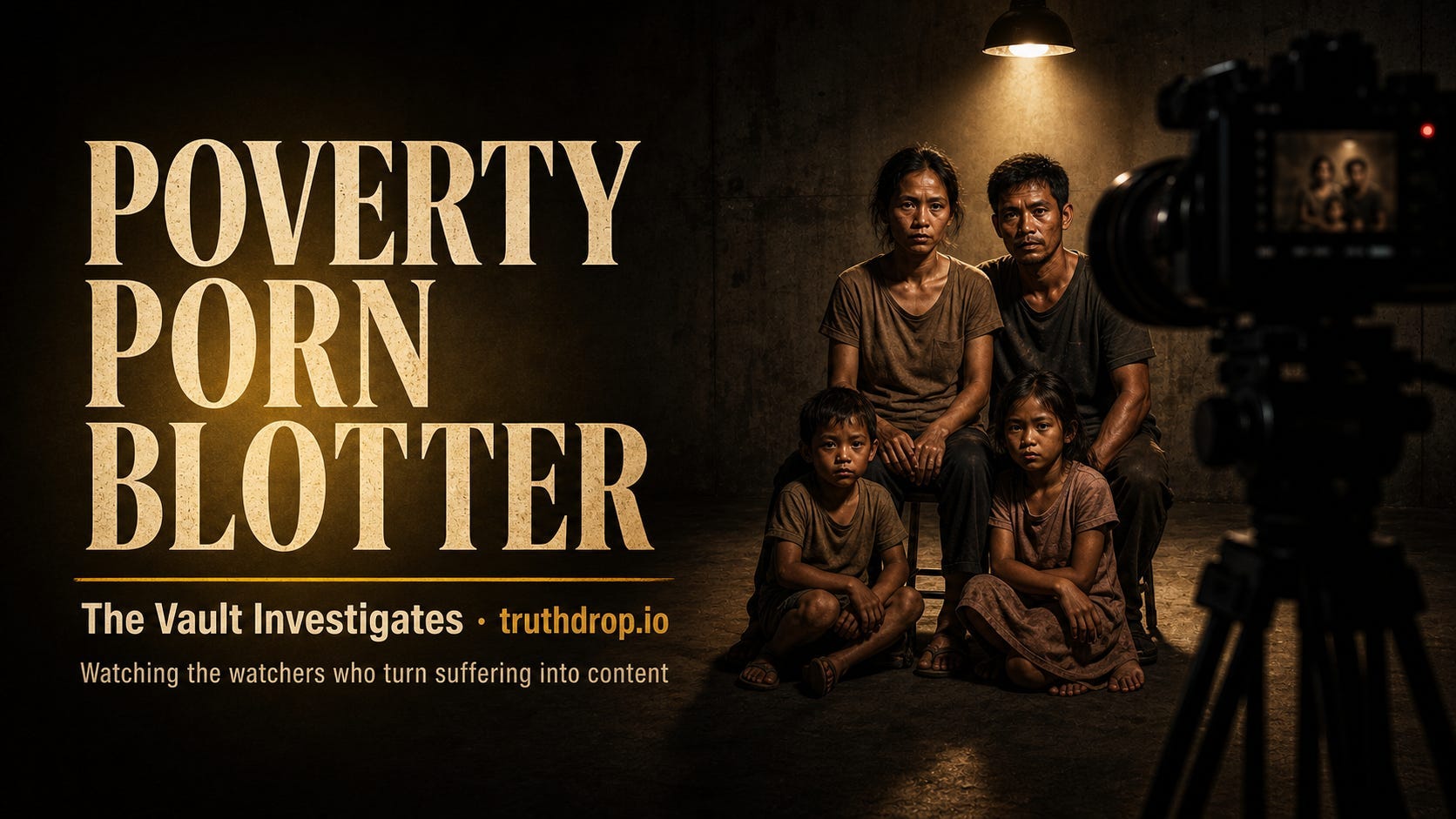
The Poverty Porn Blotter: How Algorithms Monetize Misery
Inside the Global Content Machine Turning Human Suffering into Clicks, Cash, and Data
Welcome to The Poverty Porn Blotter on Truthdrop.io, your investigative portal tracking the intersection of human suffering and digital capitalism.
The term “poverty porn” was originally coined to describe the 1980s charity campaigns that used shocking, out-of-context images of malnourished children to solicit donations. Today, this phenomenon has mutated into a multibillion-dollar digital industry. Armed with ring lights and GoFundMes, modern content creators, voluntourists, and “family vloggers” are turning the world’s most vulnerable people into raw material for clicks, clout, and ad revenue.
Under the guise of “raising awareness,” the digital attention economy has built a machine where extreme suffering is repackaged as entertainment. Here is how the misery-industrial complex operates today.
Chapter 1: The “Savior” Creators and the Commodification of Crisis
The digital age has ushered in a wave of creators who use homelessness and addiction as launchpads for their own fame and fortune. On platforms like YouTube, there are currently nonstop livestreams broadcasting the streets of Kensington in Philadelphia—an open-air drug market—24 hours a day. Thousands of viewers log in to watch people in the throes of severe addiction, generating up to $9,000 a month in ad revenue and donations for the faceless channel owners.
When creators do step in front of the camera, the ethics often worsen. YouTubers like Tyler Oliveira have built channels with millions of subscribers by barging into the tents of unhoused individuals without consent, mocking their living conditions, and falsely framing homelessness as a “lifestyle choice” to rage-bait their audience.
Even channels praised for “humanizing” the fringes of society cross severe ethical lines. Mark Laita’s Soft White Underbelly conducts raw interviews with severely addicted, trafficked, and mentally ill subjects. While Laita sets up GoFundMe campaigns for his subjects, he operates without professional oversight, unilaterally controlling hundreds of thousands of dollars in donations. The power imbalance is massive: vulnerable people, often intoxicated or traumatized, cannot properly consent to having their darkest moments broadcast to millions. In the end, the creator plays the hero while the subjects are reduced to passive, profitable spectacles.
Chapter 2: Slum Tourism and the White Savior Brand
The exploitation of poverty isn’t limited to urban America; it is a global tourist attraction. “Slum tourism” has exploded in locations like the Dharavi slum in Mumbai, the favelas of Rio de Janeiro, and the townships of South Africa. Tourists pay to walk through areas of extreme deprivation, an act widely criticized as voyeuristic “poverty tourism” that turns people’s daily hardships into amusement parks for the privileged.
This pairs perfectly with the rise of “voluntourism,” where Western travelers pay to do short-term charity work in the Global South. As documented by countless Instagram posts, the real objective is often self-branding. Volunteers use black and brown children as props for their photos, creating a “White Savior” narrative that centers their own heroism while erasing the agency and dignity of the local community.
This performative charity has become so cliché that it spawned the viral parody account Barbie Savior, which uses a Barbie doll to mock the absurd, self-congratulatory posts of voluntourists taking “slumfies” (slum selfies). But the reality is far from funny: these images perpetuate neo-colonial stereotypes, framing entire nations as helpless and dependent on Western intervention.
Chapter 3: The Kidfluencer Crisis and Digital Child Labor
Perhaps the most insidious form of modern exploitation is happening inside affluent homes. The “family vlogging” and “kidfluencer” industry turns childhood into intellectual property and digital labor.
Parents document the daily lives, tantrums, and milestones of their children, reaping millions in sponsorships and AdSense revenue. Because digital content creation happens in the private sphere of the home, it exists in a legal gray area. Unlike traditional child actors, kidfluencers are largely unprotected by the Fair Labor Standards Act (FLSA) or “Coogan Laws,” meaning parents can force their children to work unregulated hours and legally pocket 100% of their earnings.
The psychological toll is immense. In notorious cases like the DaddyOFive YouTube channel, parents subjected their children to screaming, property destruction, and emotional abuse disguised as “pranks” to generate viral clicks, leading to the parents losing custody of two of the children. Furthermore, the lack of privacy exposes these children to extreme digital dangers. Innocent videos of children are frequently scraped by predators, traded on the dark web, and fed into the multibillion-dollar Child Sexual Exploitation Material (CSAM) economy.
Chapter 4: Bridging the Dignity Gap
If the digital attention economy naturally rewards sensationalism, shock value, and exploitation, how do we fix it? The answer lies in enforcing digital literacy, media ethics, and platform accountability.
To break the cycle of poverty porn, content creators and journalists must adopt dignity-first storytelling. This means establishing true, informed, and revocable consent, ensuring that vulnerable subjects understand the reach of the internet. It means providing context—shifting the focus away from individual failings or graphic trauma and pointing the camera at the systemic issues (like housing shortages, lack of healthcare, or unfair labor laws) that cause poverty in the first place.
Instead of showing helpless victims waiting to be saved, ethical media must amplify the voices of the marginalized, portraying them as active agents capable of leading their own change. Until platforms regulate the monetization of misery and audiences stop clicking on exploitative content, the poverty-industrial complex will continue to thrive.
The Vault Investigates was founded by a disabled vet who now puts part of his Social Security and VA disability checks into making amends—after years in NGO work, greed, and becoming part of the poverty-pimp system himself. Built on sleepless nights, deep research, and relentless digging, this project exists to expose what once corrupted him. Support the work.
The Vault Investigates / Truthdrop.io
Independent investigations cost time, labor, and risk. Support the work. Tip the newsroom. Fund the next exposé.
Buy Me a Coffee · GoFundMe · Ko-fi
Support My Work!
https://buy.stripe.com/8x26oG9mmgxbeYAeFKdQQ00
Subscribe to the Poverty Porn Blotter on Truthdrop.io to stay informed and help us make the truth louder than the algorithm.