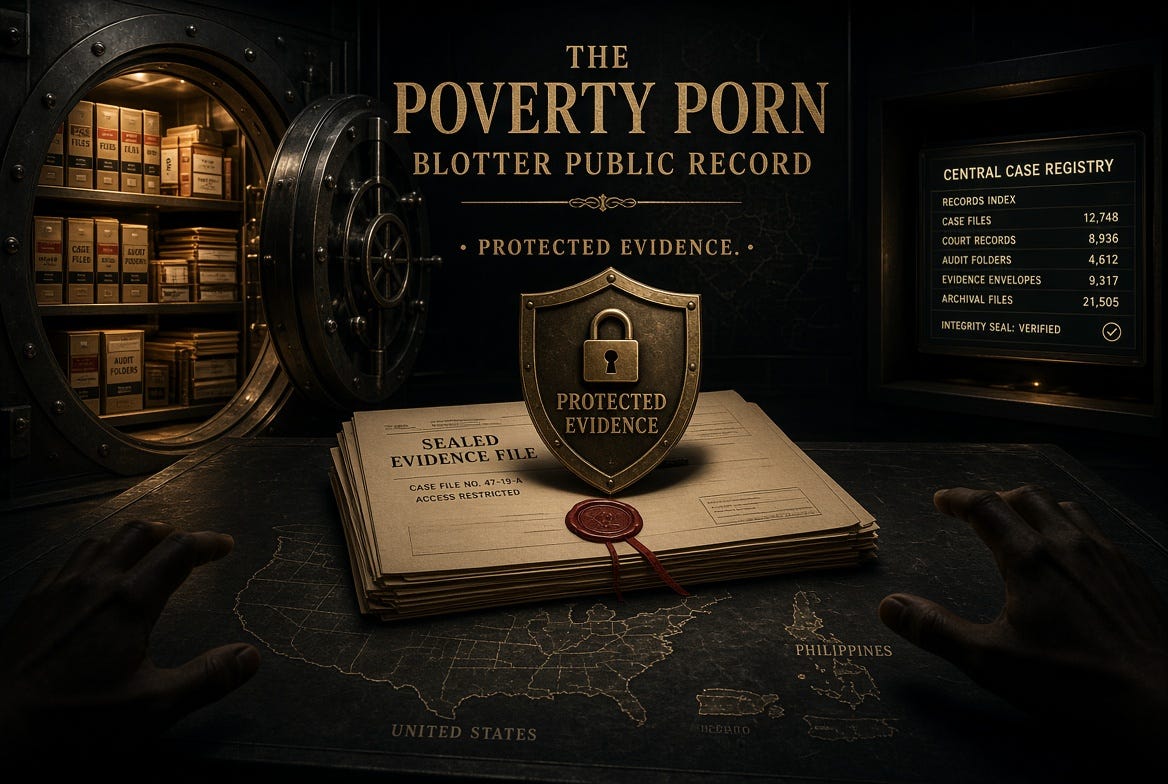
The Poverty Porn Blotter is now live as part of The Vault Investigates Intelligence Commons.
This public registry documents reported cases involving the exploitation of poverty, vulnerability, trauma, and human suffering for attention, influence, advertising revenue, fundraising, or political gain.
The objective is accountability—not spectacle.
What the public can access
Readers can now:
Search published incidents
Review documented case summaries
Follow available evidence links
Report a new incident
Use the Rights & Dignity resources
Apply for vetted investigative access
Visit the public registry:
OPEN THE POVERTY PORN BLOTTER →
Protecting evidence integrity
Public access must never mean unrestricted control over investigative materials.
Accountability cards, evidence-recovery tools, and administrative case functions are now restricted to the vetted investigative environment. This helps reduce the risk of altered graphics, misleading reproductions, missing context, or materials being presented as official when they are not.
The public can still examine published information and follow supporting evidence. Researchers and investigators who require additional tools may request vetted access.
Why the Blotter exists
Poverty content is often treated as harmless entertainment.
It is not harmless when vulnerable people become props.
It is not harmless when children, unhoused people, disaster survivors, people with disabilities, or families in crisis are filmed without meaningful consent.
It is not harmless when suffering becomes a business model while the people displayed receive no protection, ownership, accounting, or lasting benefit.
The Blotter creates a public record of these patterns.
It is designed to help journalists, researchers, educators, affected communities, and the public examine how dignity can be traded for traffic—and how attention can be converted into money, influence, and institutional power.
Evidence before opinion
An entry in the Blotter should never be treated as permission for harassment or retaliation.
Cases require careful sourcing, clear status labels, documented evidence, and an opportunity for correction when verified information changes. Reporting must distinguish between allegations, documented findings, editorial analysis, and unresolved questions.
The purpose is to preserve evidence and encourage accountability—not to create another outrage machine.
Report an incident
If you have witnessed exploitative filming, staged charity content, coercive storytelling, privacy violations, financial pressure, or the exposure of vulnerable people without meaningful consent, you may submit a report for review.
Do not submit classified information or material obtained unlawfully.
Enter the Intelligence Commons
The Blotter is one part of a larger public-interest system connecting investigations, evidence intake, archival preservation, vetting, and publication.
Read the latest public investigations at:
Independent investigative work requires time, records access, secure infrastructure, and careful preservation. Readers who want to help sustain that work can use the support links below.
Ko-fi — Intelligence Commons Circle →
If financial support is not possible, sharing the Blotter and our public investigations remains equally valuable.
Truth before traffic. Evidence before opinion.
Veritas Unum Est — There is only one truth.
— @TheVaultArchivist
The Vault Investigates Intelligence Commons