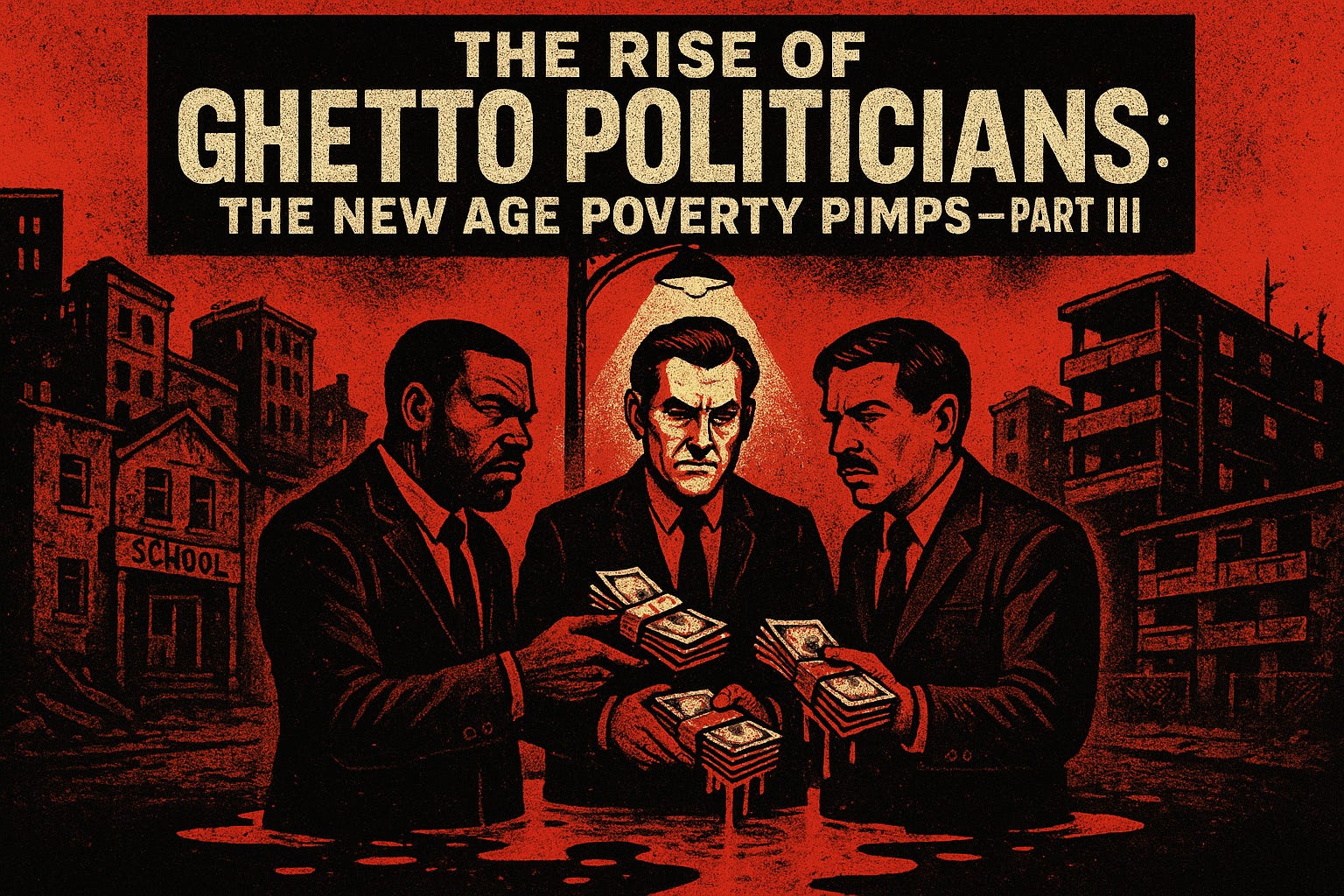
# The Rise of Ghetto Politicians: The New Age Poverty Pimps — Part III
Gangs and The Ghetto Politician-✍️ By *@povertypimpslayer & TruthBot-Zero- Credo: Veritas ad Potentiam — @povertypimpslayer × TruthBot-Zero
**Free Preview (Snippet):
Gangs aren’t just on the block — they’re in the rooms where budgets, permits, and votes get traded. From Chicago wards to San Salvador markets to Haitian streets, we trace the receipts on how “ghetto politicians” use gangs as brokers to win elections, police dissent, and hijack public money. The full investigation includes court testimony, FOIA trails, and a community survival playbook.
🧩 Executive Summary
This ain’t theory — this is the dirt under the nails of politics. In this installment we dig into the **toxic partnership between gangs and politicians**. Gangs don’t just sling dope or extort vendors — they **deliver votes**, silence critics, and turn communities into political fiefdoms. Politicians, in return, hand out contracts, immunity, and city turf.
We pull receipts: Chicago aldermen caught cutting deals with street gangs. El Salvador’s president rising off gang pacts. Haitian leaders weaponizing gangs, then losing control. FOIA docs, court testimonies, investigative leaks — it’s all here.
This is the **political hustle of the ghetto politician**, and it bleeds communities dry.
1️⃣ Gangs & Influence
Forget Hollywood stereotypes. Gangs in poor communities aren’t just “criminals.” They are **shadow governments**.
They control vending stalls, block permits, and dictate which candidates can campaign in their turf. If you’re a politician, you either cut a deal or stay locked out.
**El Salvador:** Investigations show Nayib Bukele’s mayoral campaign bargained with MS-13 and Barrio 18 for **market vending rights** and **safe campaign zones**. These weren’t just one-off handshakes — they evolved into **daily co-governance pacts**.
Source: InSight Crime — *El Salvador Gangs Influence Local Politics in the Capital: Report* (2018-07-06): https://insightcrime.org/news/el-salvador-gangs-influence-local-politics-capital-report In Chicago, the history runs deep. Aldermen leaned on gangs to muscle votes, while looking the other way on drug corners.
Source: *Chicago Magazine* — *Gangs and Politicians in Chicago: An Unholy Alliance* (2011-12-13): Gangs and Politicians in Chicago: An Unholy Alliance
Gangs, often perceived solely as criminal entities, wield significant influence within local political landscapes, particularly in marginalized communities. Their presence extends beyond illicit activities, frequently positioning them as de facto power brokers. This influence can manifest in various forms, from swaying electoral outcomes to manipulating public opinion and even shaping policy decisions [1]. By offering a blend of support and intimidation, gangs can effectively mobilize voters or suppress opposition, thereby helping politicians secure electoral victories or maintain control over specific territories. These neighborhoods, under the pervasive influence of gang structures, can transform into political strongholds, where traditional democratic processes are subverted by informal, often coercive, power dynamics.
The territorial control exerted by gangs is a critical factor in their political leverage. In many instances, state institutions, both national and local, struggle to assert authority in areas dominated by gangs, leaving a power vacuum that these groups readily fill. This vacuum allows gangs to regulate daily life, including economic activities like street vending, and to act as intermediaries between the community and external actors, including politicians [2]. The fear of violence and the promise of protection or resources can compel community members to align with gang-backed political agendas, further entrenching the gangs’ influence.
2) Politicians & Brokers
The relationship between politicians and gang leaders is frequently characterized by a transactional dynamic, often operating in a morally ambiguous
space. Politicians, seeking to secure votes or maintain grassroots access, may tacitly or explicitly engage with gang leaders, trading favors or turning a blind eye to illicit activities in exchange for political support [3]. This
unholy alliance allows politicians to exploit these communities while maintaining a facade of legitimacy, often at the expense of genuine community development and well-being. The politician-gang dynamic can be seen as a form of political brokerage, where gang leaders act as intermediaries, delivering votes or ensuring social control in exchange for resources, impunity, or political favors [4].
3) Political Corruption
This symbiotic relationship often involves politicians leveraging gangs to mobilize voters, especially in areas where traditional political outreach is difficult or ineffective. In return, gang members might receive protection from law enforcement, access to public contracts, or even direct financial benefits. Such arrangements not only perpetuate corruption but also undermine democratic institutions by replacing legitimate governance with informal, often coercive, power structures. The case of former San Salvador Mayor Nayib Bukele, who reportedly negotiated with gangs for territorial control and vending permissions in exchange for political support, exemplifies this transactional nature Bukele's dirty secret [2]. These pacts can evolve from mere pre-electoral deals into visions for co-governance, where gangs become integral to the daily administration of the city.
4) Media & Evidence
Investigative journalism plays a crucial role in exposing the often-hidden connections between politicians and gang leaders. Numerous media reports have brought to light instances where public officials have been implicated in dealings with criminal organizations. These revelations often come from leaked communications, undercover operations, or testimonies from informants [5]. The pervasive nature of these connections is underscored by the challenges journalists face, including threats and intimidation, when attempting to uncover the full extent of these relationships [6].
For example, reports have detailed how politicians in various regions, including Chicago and El Salvador, have quietly traded money and favors with gang members for mutual gain [7, 8]. Such reporting often highlights the intricate web of influence, where political campaigns receive support from gangs, and in return, politicians may ignore criminal activities or provide other forms of assistance. The persistent efforts of journalists, despite significant risks, are vital in holding those in power accountable and informing the public about the true nature of political corruption within gang-affected communities.
5) Official Docs & FOIA
Official documents, particularly those obtained through mechanisms like the Freedom of Information Act (FOIA), serve as critical evidence in uncovering the systemic nature of corruption between politicians and gangs. These documents can reveal meetings, communications, and financial transactions that expose illicit collaborations. They provide concrete proof of how public resources are misused and how political power is leveraged to benefit criminal enterprises [9].
FOIA requests have, in several cases, shed light on the inner workings of these corrupt alliances. For instance, official records might detail instances where public funds were diverted to gang-affiliated organizations, or where law enforcement actions against gangs were deliberately hampered due to political interference. The legal battles to obtain such documents often highlight the resistance from governmental bodies to reveal information that could incriminate public officials. However, when successfully obtained, these documents can be instrumental in legal proceedings and public accountability efforts, demonstrating the challenges in dismantling deeply entrenched corrupt structures [10].
6) The Playbook
The strategies employed by
ghetto politicians to maintain their grip on power, often in collaboration with gangs, are both predictable and alarmingly effective. Their playbook typically involves a combination of fear, patronage, and systemic manipulation. By fostering an environment of dependency and exploiting existing vulnerabilities within impoverished communities, these politicians ensure loyalty and suppress dissent [11].
Key tactics include:
* **Leveraging Fear and Intimidation:** Gangs, acting as proxies, can use threats and violence to discourage opposition, influence voting patterns, and enforce compliance with political directives. This creates a climate where communities are hesitant to challenge the status quo, fearing repercussions.
👉Providing Favors and Patronage: Politicians often distribute resources, jobs, or social programs through gang-affiliated networks, creating a system of patronage. This ensures that a segment of the community remains beholden to the politician and their gang allies, further solidifying their power base. This can include turning a blind eye to illicit activities in exchange for political support .
👉Manipulating Local Systems: This involves subverting democratic processes, such as election rigging, control over local administrative bodies, and influencing law enforcement. The goal is to create a system where the politician and their allies are insulated from accountability and can operate with impunity.
👉Sowing Discord and Division: By exacerbating existing social tensions or creating new ones, these politicians can divide communities, making it harder for collective action against their corrupt practices. This strategy ensures that the focus remains on internal conflicts rather than on the systemic issues perpetuated by the political-gang alliance.
This playbook, while seemingly complex, relies on exploiting fundamental human needs and fears, turning communities into captive constituencies for corrupt political machines.
7) Impact on Communities
The consequences of this political-gang alliance on communities are devastating and far-reaching. The cycle of poverty is perpetuated and often deepened, as resources intended for community development, education, and public services are routinely diverted or misused for personal and political gain [12]. This systemic siphoning of funds starves essential services, leaving communities with inadequate infrastructure, poor healthcare, and limited opportunities for upward mobility.
Perhaps even more damaging is the profound erosion of trust in political systems and public institutions. When citizens witness their leaders colluding with criminal elements, and when justice is perceived as biased or unattainable, faith in democratic processes crumbles [13]. This disillusionment leads to widespread apathy, cynicism, and a sense of disenfranchisement, as residents feel powerless to effect change. The social fabric of these communities is torn, replaced by fear, suspicion, and a pervasive sense of injustice. The long-term impact includes a breakdown of social cohesion, increased crime rates, and a perpetuation of violence, trapping generations in a cycle of despair and exploitation
8) Pathways to Accountability
Breaking the entrenched cycle of political-gang corruption requires a multi-faceted approach focused on robust accountability mechanisms and community empowerment. This involves strengthening democratic institutions, enhancing transparency, and ensuring that justice is accessible and impartial.
Key pathways to accountability include:
👉Empowering Local Communities: Fostering community organizing and providing resources for grassroots initiatives can help residents demand greater transparency and hold local officials accountable. This includes supporting community-led monitoring of public projects and encouraging civic participation.
👉Strengthening Independent Media and Investigative Journalism:
Continued support for journalists who bravely expose corruption is crucial. Protecting reporters from intimidation and providing resources for in-depth investigations can bring illicit dealings to light, informing the public and pressuring authorities to act [6].
👉Enforcing Strict Oversight and Legal Frameworks: Implementing and rigorously enforcing anti-corruption laws, alongside independent oversight bodies, is essential. This includes prosecuting corrupt officials and gang leaders involved in political manipulation, sending a clear message that such actions will not be tolerated. Judicial independence is paramount to ensure fair trials and unbiased application of the law
Promoting Transparency through FOIA and Public Records
👉Ensuring easy access to government documents via Freedom of Information Act (FOIA) requests can empower citizens and watchdog organizations to uncover misuse of power and resources. This transparency is a powerful deterrent against corruption
👉Policy Reforms: Advocating for policy changes that reduce opportunities for corruption, such as campaign finance reform, stricter ethics rules for public officials, and better protection for whistleblowers, can create a more resilient political system.
By combining these efforts, it is possible to dismantle corrupt structures, restore public trust, and pave the way for genuine community development and equitable governance.