



In collaboration with Anonymous Media Group and The Dirty Dozen Dispatch
If you haven’t read Part I — “Smile for the Camera” — start there. It’s free. It explains the machine. This part names the operators.
Dear friends,
In Part I, we built the architecture.
We showed you how Philippine poverty became a content genre — a three-market economy running on emotional logic, algorithmic incentives, and the near-total absence of financial accountability.
59.6 million Filipinos on YouTube. A platform that earns 45 cents of every ad dollar generated by suffering on screen. A regulatory framework that exists on paper and gets enforced one high-profile case at a time.
Now we name names.
This is Part II: The Roster.
The creators. The channels. The subscriber counts. The estimated earnings. The business models. And the case that proved — in the most explicit terms possible — what happens when a YouTube channel stops being content and becomes an institution.
Every claim in this article has a receipt. 🗂️ Receipts folder: https://github.com/PapiRicanPI/the-vault-investigates-receipts/tree/main/PovertyPorn
BEFORE WE NAME NAMES — THE STANDARD WE USE
The Vault Investigates does not name people to destroy them. The Vault Investigates names people because opacity is the product.
Every creator named in this article meets all three of the following criteria:
1. They publish recurring poverty-centered content — charity vlogging, social experiments, rescue narratives, or slum-tour adjacent formats — as their primary or significant content category.
2. They are repeatedly discussed in Filipino public discourse as examples of poverty-content monetization — in news coverage, social commentary, or regulatory action.
3. They have sufficient public metadata — channel pages, analytics dashboards, regulatory records, or news documentation — to cite responsibly.
We use Social Blade and vidIQ earnings estimates as triangulation signals only — not as proof of income. They are model-based ranges, not audited statements. Where we say “estimated,” we mean estimated.
CHAPTER 1 — THE GENRE AND HOW IT WORKS
Before the roster, understand the formula.
Philippine charity vlogging did not invent poverty content. It industrialized it.
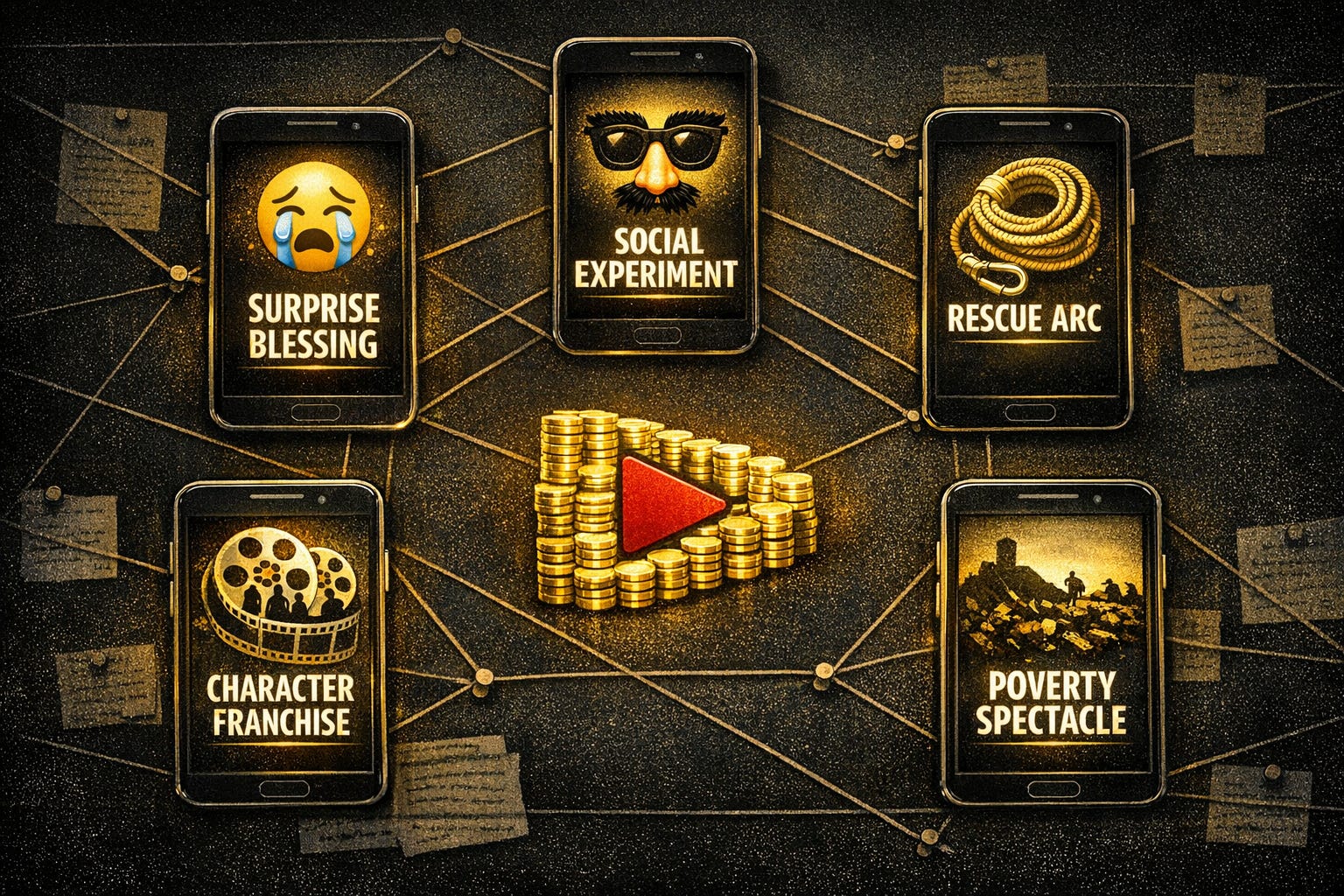
The genre runs on five recurring formats — each one algorithmically optimized, each one emotionally engineered, each one profitable in a specific way:
FORMAT 1: THE SURPRISE BLESSING Cash handouts. Grocery drops. Debt payoff. Medical bills covered. Housing revealed. Edited around tears, gratitude speeches, moral lessons. The give is real. The filming is the product. The emotional peak — the moment of tears — is the content unit that drives watch time, shares, and return viewers.
FORMAT 2: THE SOCIAL EXPERIMENT / PRANK The creator disguises themselves as poor. Tests whether passersby will help. Rewards the “good” ones with money. This format turns poverty into a costume. It turns moral behavior into a performance test. It turns the poor — the real poor, watching — into props in someone else’s virtue theater.
FORMAT 3: THE RESCUE ARC Homeless individuals. Children at risk. Vulnerable adults. Repeat appearances. Narrative of transformation across multiple episodes. The recipient becomes a character. The audience becomes invested in their outcome. The creator becomes the hero of the story.
FORMAT 4: THE POVERTY SPECTACLE Dumpsites. Cemetery dwellers. Pagpag. Tondo. Smokey Mountain. Informal settlements. Framed as “shock knowledge for outsiders.” The locations become sets. The residents become backdrop. The views become revenue.
FORMAT 5: THE CHARACTER FRANCHISE The most sophisticated — and most troubling — format. Recipients become recurring cast members. Fans follow their stories across episodes. The machine has a financial incentive to keep people in crisis. Not because creators are evil. Because the algorithm rewards suffering more than it rewards resolution.


